Petition | Family of Cruz Patiño started this petition to Pima County Sheriff Chris Nanos; Tucson Mayor Regina Romero; Arizona Attorney General Mark Brnovich; Arizona Governor Doug Ducey;Arizona State House;Arizona State Senate | change.org
Together, We Can Be The VOICE!
In The Year (2021) 11 Individuals Including Young Cee-Jay (Cruz Patino) Sadly Lost Their Life In Pima County Jail (PCJ).
Together, We Can Be The VOICE! of CeeJay & (ALL) Others Who Lost Their Precious Life.
RIGHT NOW!, We Have A Critical Opportunity To “Shine A Light” On The Pima County Adult Detention Center (PCJ) For The Unjust, Negligent, & Unsafe Policies, Procedures, & Staff Conduct That Is Currently Taking Place.
With Your Help!, We Can Reform, Revise, Induct, & Establish Comprehensive Policies,& Procedures That Ensure The Well-Being Of Incarcerated Human Beings (Our Loved Ones) Confined Within That DEATH-TRAP.
#WeAreHere for #JusticeReformNOW! #Rest-In-Everlasting-Peace (CeeJay) (J-Mack)(Jacob)
WE ARE CALLING FOR AN IMMEDIATE! (IN-DEPTH)TRANSPARENT INVESTIGATION ON (PCJ)!!!!!
GRIEVING FAMILIES TELL LAURA CONOVER: YOU HAVE BLOOD ON YOUR HANDS
TUCSON, Arizona–On Monday, March 21 at 4pm, community members will gather outside Pima County Attorney Laura Conover’s office to demand accountability for those killed in the Pima County Jail and by law enforcement in Tucson.
“They haven’t done a thing to address the conditions that led to my son’s death,” said Rosanne Inzunza, whose son Sylvestre Miguel Inzunza died in the Pima County Jail in February. “All we’ve heard from Conover are empty promises and fake condolences. Until we see real action, we’re going to keep protesting.”
In 2021, one of our community members died in the Pima County Jail every 31 days. On November 29, 2021, TPD Officer Ryan Remington shot Richard Lee Richards in the back 9 times, executing him in his wheelchair for suspicion of shoplifting. On March 12, a Pima County Sheriff’s Deputy shot and killed a 17-year-old boy, Zakareya Ibrahim, instead of offering him the mental health support he needed.
In the midst of this crisis, Laura Conover has refused to take any action to hold law enforcement accountable for their violence toward her constituents. Although multiple families have formally sought charges of negligent homicide against the Pima County Sheriff who runs the jail, Conover has done nothing to hold him accountable.
She has refused to file criminal charges against any of the officers involved in this spate of deaths, prioritizing instead warm relationships with law enforcement. In recent weeks, she has rolled back campaign promises to discontinue charging people for low level drug offenses, yet another sign she is choosing to prioritize criminalization over protecting people from the deadly conditions within the jail. She cannot continue to shirk responsibility for her role in the deaths of Pima County residents.
Laura Conover has blood on her hands.
“Don’t wait until it happens to your son,” said Inzunza. “Come out and join us.”
After the Pima County jail reported a decade-high number of deaths in 2021, Sheriff Chris Sheriff Nanos spoke to the Board of Supervisors on Tuesday to answer key questions about drug overdoses and staffing issues at the facility.
Since January 2021, the jail has reported 12 deaths at its facility, with two fentanyl-related overdoses reported this year.
Including the two deaths this year, five of the deaths were attributed to drug overdoses, with the most recent four caused by fentanyl. Three of the deaths resulted from medical complications, three from COVID-19, and one from suicide, according to the Pima County medical examiner’s findings. Of the 12 inmates, eight were people of color.
Supervisor Matt Heinz put the board’s discussion with the sheriff on Tuesday’s agenda amid scrutiny the Sheriff’s Department is facing for the deaths and outcry from advocates and family members of deceased inmates.
“I think this is really good to get out there for the public to continue to have this discussion in a very public and very transparent way,” he said. “This is a problem, and we need to own it and we need to figure out how this is happening.”
The last four deaths at the jail were attributed to overdoses. On Jan. 14, Pedro Xavier Martinez Palacios Jr., 24, was pronounced brain-dead at St. Mary’s Hospital after being transferred there for an overdose. On Feb. 2, Sylvestre Miguel Inzunza, 18, was pronounced dead at the jail, and the medical examiner later attributed the death to fentanyl intoxication.
Nanos told the board every corrections officer now has access to Narcan, whereas in the past, only the jail’s private medical providers administered the drug designed to reverse opioid overdoses. Regardless, inmates are still accessing the drugs that require overdose reversal.
Board Chair Sharon Bronson cut the conversation off after about 25 minutes, but Heinz said he wanted to know more about how fentanyl is getting into the jail population.
Nanos told the board “we are doing everything possible” to keep fentanyl out of the jail without providing many specifics. He said every death is investigated by sheriff’s personnel and discussed among officials from the county Health Department, the County Attorney’s Office, the medical examiner and NaphCare, the private correctional health care provider the county contracts with.
The sheriff said his department has presented a criminal case to the county attorney against an inmate who allegedly provided fentanyl to another inmate who died from an overdose. Nanos didn’t specify which inmate the case is in reference to.
“We sit down and discuss each and every incident and try to find where maybe we missed something,” Nanos said.
Heinz also asked Nanos about COVID-19 protocol at the jail. In 2021, the facility reported three COVID-related deaths. As of yesterday, the jail had 15 inmates who tested positive for the virus, Nanos told the board.
Universal masking is required at the jail, according to the sheriff, and inmates undergo a 14-day quarantine upon arrival.
However, Nanos said, the isolation protocol “creates double the work.”
“We have to deal with classification and placement of individuals, then have to do isolation,” he said. “It doubles that amount of work, the resources are doubled as well in terms of needs. So if we can reduce some of those timelines, it will help that staff over there tremendously.”
The increased work is compounded by a lack of adequate staffing at the jail. As of last week, the facility was short-staffed by 104 corrections officers, five corrections sergeants and two corrections lieutenants, according to the Sheriff’s Department.
“It would lead some to believe that perhaps the staffing issues contributed to the deaths because of the jail population and the reduced staffing oversight,” Supervisor Steve Christy said, later asking Nanos if he still supports the board’s vaccine mandate that extended to jail employees.
That mandate, which the board approved in October to require county employees deemed to work with vulnerable populations to be fully vaccinated by the end of 2021, resulted in the termination of 17 jail employees, according to numbers the county reported in January. It’s unclear, however, how many jail employees left voluntarily as a result of the mandate.
“The more staff we have, we can throw at the problem, I think the safer we are in that facility,” Nanos said. “So yes, staffing can certainly, I believe, help us there.”
But Nanos told the board he does not regret supporting the vaccine mandate for jail employees.
“When I made that decision, I have to handle all areas, not just fentanyl, not just staffing, but COVID as well. And that was a part of the problem,” he said. “The decision to mandate people getting vaccinated to protect those we serve was my decision.”
Christy followed up by asking the sheriff if that sentiment was relayed to the families of the deceased inmates, many who have gathered at the jail to demand answers about the deaths of their loved ones.
“I don’t know that. I myself have never spoken to those families. My cellphone number is out there, the whole world, everybody can contact me, I have never turned down anybody’s call,” Nanos said. “I don’t want to appear to politicize some of this. … My heart goes out to them. I feel for them.”
Reflection on recent round of noise demonstrations outside of the Pima County Detention Center in so-called Tucson, Arizona.
What follows is a brief reportback from the birthday noise demo outside the Pima County Detention Center in Tucson on Friday, February 11th, 2022. A longer report on the struggle that has emerged around the jail in general is hopefully coming soon.
Difference
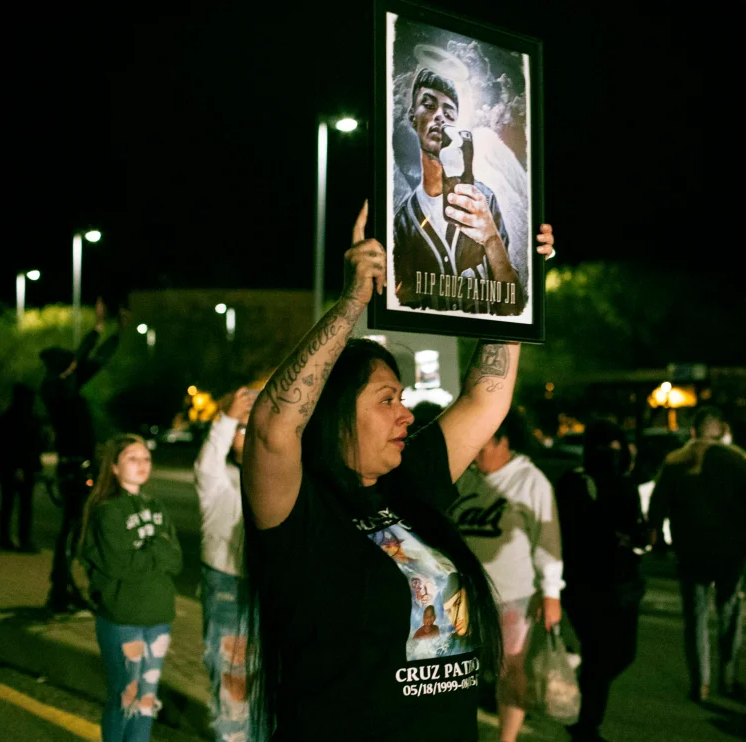
This third noise demo was called to coincide with Frances Guzman’s birthday for many reasons. One being that she wanted to mark her first birthday without her son, Cruz Patiño Jr, in a way that would truly honor him. Another, to demand answers for why her son and so many others have lost their lives in the depths of that cold and dead building. Another, might be that she and others currently have loved ones in that jail, the same jail which has swallowed one life per month for the last year.
The reasons folks decided to attend are at least as numerous as how many showed up, which was around 150 people. There were so many children and so many families. It is tempting to describe how their numbers compare to the “political people” who showed up, the ones the news or liberals would parrot the Pima County Sheriffs in calling the trouble makers, outsiders who have no stake in the dismantling of this jail, whose privileged lives have afforded them little to no contact with the subtle misery of something like the cold concrete of a holding cell’s floor.
The first step in countering an emergent, combative movement is to define and therefore put as much distance between the active combatants from those who might support their combat. A closer look easily reveals this as a purely policing operation, the deliberate creation of a combatant, set apart from a combative crowd. This doesn’t mean there is no difference amongst the crowd, but the lines aren’t so easy to draw if we can acknowledge that underneath the black hoods and behind the banners are those who have lost loved ones to state violence or spent time in cells themselves. Some may even feel they have only found something like “safety” in a crowd of angry and determined people, willing to act and to protect each other.
Emergence
So the crowd, in all its difference, assembled at 7pm outside the Jail much like it had in previous months. This time the visible presence of families was much larger than the last, each time it has grown as the families’ networks have expanded rapidly. This time we kicked the night off with Frances taking the first swings at a piñata of the jail, busting candy everywhere, followed by an assortment of children wailing on the effigy. We sang happy birthday to Frances and heard some brief but powerful thoughts from other families. The latest life taken, Sylvestre Miguel Inzunza, was only 18. His family came out in huge numbers. Sylvestre only died last week and at the time of the demo his family had not yet laid him to rest. The urgency to do anything to stop what is happening inside was palpable.
The music cranked, an indigenous demonstrator began to smudge, and the sound built into a cacaphony of noise aimed at the walls of the jail. Soon the fireworks came out, and the children cheered. As we ran out of fireworks it was clear that the crowd was still not satisfied so they began to spill out onto Silverlake road. The jail is situated out of the way, along a wide and dark road which tends to have little traffic at night. If some of the intent of these demonstrations was to get the attention of more people and alert them to what is happening, blocking traffic on the 2nd weekend of Gem Show was a good instinct. The Gem Show in Tucson is the largest gem and mineral Show in the world. It is a mainstay for the Tucson economy, so creating even mild disturbances on its opening weekend is certain to get some feathers ruffled.
Hooded demonstrators acted quickly to make the demonstration more visible by facing traffic with banners and road flares. Parents of various people killed in the jail led chants and the whole crowd continued to make so much noise. A mobile soundsystem cranked the vibe again and some in the crowd began to dance. When we saw the red and blue lights of TPD no one seemed scared, the crowd just grew more determined and began to march towards them. Around this time the first graffiti went up on road signs.
A standoff soon began towards the east side of the jail. TPD was holding the road and redirecting traffic while a van of Sheriffs lurked in the dark near the gated entrance to the employee parking lot. Parts of the crowd confronted both simultaneously. Eventually the crowd’s primary attention fell on the Sheriffs, as they are the ones who staff the jail. We began to march towards them and their van sped off, leaving the employee parking lot entirely open. Naturally the crowd moved into the lot, surrounding a car and van full of Sheriffs that had arrived from the back. Almost immediately demonstrators set signs and pictures of lost loved ones on the windows facing inward to the Sheriffs inside. It wasn’t long before a handful of people got to work on the van. There are times in which it is clear exactly what needs to be done. Total strangers communicated through a look or a nod. When the crowd finally backed up, it was less because the bumbling line of Sheriffs had assembled themselves, but because people had already satisfied themselves with wet paint and hissing tires.
They brought a fucking dog. There were tons of kids. Fucking cowards https://t.co/kRe56RvXwx
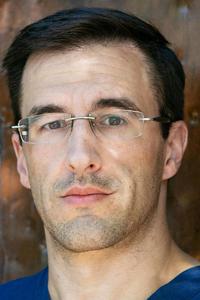
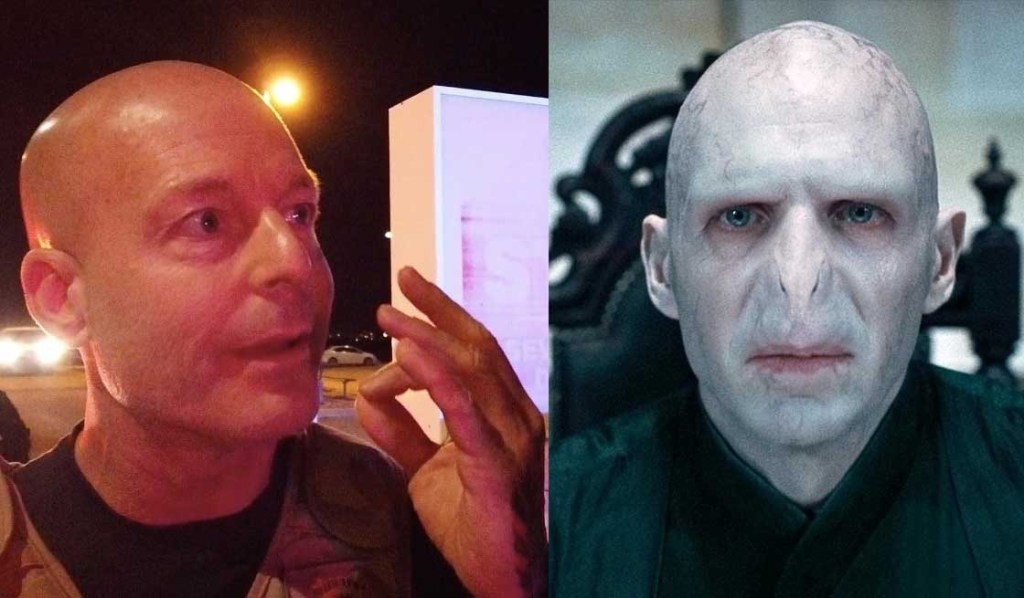
When the Sheriffs realized that some of their toys had gotten scratched, their demeanor shifted. The crowd was getting smaller and the sheriffs numbers grew. After much discussion amongst the demonstrators, folks fell back to the front parking lot where most people had parked. As the crowd slowly dispersed, the cowardly sheriffs, having suffered such bruised egos, charged a smaller group of people, apparently attempting to snatch a teenager. They later claimed in a news article the attempted arrest was for graffiti, but who knows what truth there is to that. Although it was clearly a coordinated maneuver, they made several tactical missteps which resulted in an ultimate failure to successfully arrest anyone in this particular attempt. We can break their failure into two parts. One is an emotional component and the other is technical. It appeared that the Sergeant Voldemort Svec (fig. A) both underestimated his emotional state and that of the demonstrators. He and two other sheriffs attempted the snatch by charging far ahead of the others, separating themselves from immediate back up in their overzealous attempt to avenge their van’s tires. In their miscalculation, they failed to predict that so many demonstrators would rush to the aid of the small group. Some leaping over benches to jump straight into the pile.
The sheriffs were clearly shocked by this ferocity, causing their grips to loosen and some of the rest of them to freeze and even back up instead of aiding their fellow officers. Their technical failure directly relates to their emotional failure, clearly not having much experience keeping their cool in crowd situations. This can make you wonder how many times they’ve let their emotions over take them in their brutality relating to the general public. Having successfully pulled back from the sheriffs, the crowd could see they were being flanked from the other side by a group of officers. The crowd continued to back up, some demonstrators moving slowly back using their bikes as barriers, others using their bodies to shield families with children from the kidnappers and their literal dogs. Again someone in the crowd outmaneuvered the sheriffs by letting off a smoke bomb that gave further pause to the sheriffs and helped put more distance between them and the scattering crowd. As people left the area the sheriffs pitifully screamed “Unlawful assembly! Leave now!” in an attempt to assert control where they clearly had none.
Figure 1: Sgt Voldemort Svec
Reflection
It is unfortunate that the night still ended in 2 arrests as a car was pulled over after the dispersal. Two relatives of Cruz Patiño Jr were charged with multiple felonies in a clear act of spineless but predictable intimidation of his family for seeking justice for his death. If any tactical failure exists on our side, it is a failure to properly collect and distribute information about the geographic layout of the area around the jail. It is a vast, dark, and secluded area with a small number of streets, most of which are dead ends aside from Silverlake, the main road in front of and in direct view of the jail. Tucson’s infrastructure is laid out intentionally this way, having expanded rapidly in the ’50s along with Phoenix, following more suburban, car-centered urban design which is partially meant to diminish social unrest and play in favor of surveillance and policing strategy. An aspect of this includes dispersing vital policing infrastructure through out the city, placing key hubs in secluded and isolated places that are more easily controlled and surveilled. It is absolutely crucial that those of us interested in seeing combative capacities expand in Tucson work hard to understand how this dynamic affects struggle here and come up with creative tactics and strategies to circumvent it. Nonetheless, as the energy of the families continues to ramp up and people’s creative capacity for resistance continues to push boundaries, it is clear that this fight is far from over even in the face of repression.
Shelle Jackson, KVOA | Published February 12, 2022 | Last updated February 12, 2022 (As of March 11, 2022)
TUCSON (KVOA) – Two men arrested Friday night after a protest at the Pima County Jail were released Saturday morning.
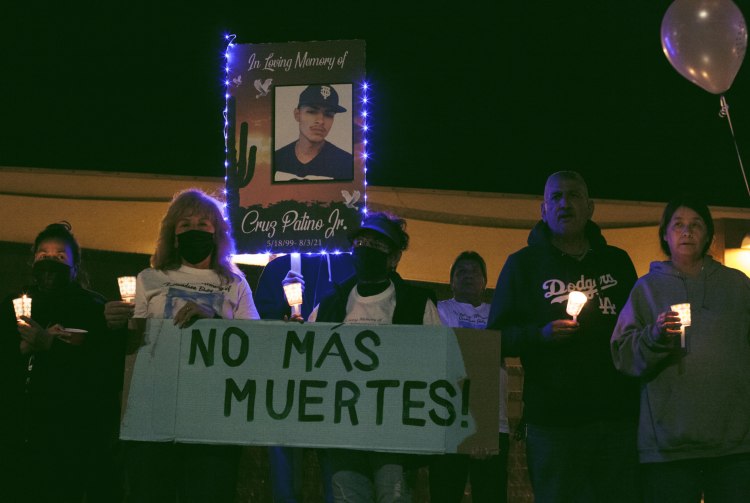
More than 150 people gathered at the jail Friday. No More Deaths said the protest was a celebration for Frances Guzman’s birthday. She had asked the community to show up in honor of her son, Cruz Patino, Jr., who died while he was in custody.
Rosanne Inzunza’s 18 year old son died February 2nd while in custody at the Pima County Jail. “He was in perfect health, no health issues. I don’t understand, he was here on week and, he went to court and then we found out he was gone,” she said.
Inzunza was one of dozens of protestors gathering Friday night to draw attention to what they say is a growing problem at the Pima County Jail.
“People need to know. The community needs to know something isn’t right. We don’t know what’s going on in there but There’s too many deaths that are happening, IN people that are healthy and for no reason or dying. there’s something going on in there,” she said.
According to the Pima County Public Defender’s Office 21 inmates have died in the Pima County Jail over the past 26 months. “There is a concerning pattern of young men of color being found unresponsive in their cells and being pronounced dead either in the jail’s facility or shortly thereafter when they were taken to the hospital,” said Sarah Kostic, with the Pima County Public Defender’s Office.
Public Defender, Joel Feinman, said the community needs to know what is going on at the county jail. “If one or two people a month were killed in our schools, if one or two school children were killed if one or two church goers were killed the community would be up in arms. But because they are our clients, because they are poor, because they are indigent, because they are disproportionately people of color, it’s okay,” Feinman said.
News 4 Tucson has reached out to the Pima County Sheriff’s Office for comment, we have not heard back.
FATHER & BROTHER OF GRIEVING MOTHER ARRESTED AT PROTEST AGAINST JAIL DEATHS
TUCSON, Arizona–Last night, February 11, 2022, two people were arrested and a third was detained for several hours following a protest at the Pima County Jail.
The protest was a celebration for Frances Guzman’s birthday. An unlikely place to hold a birthday party, Guzman asked the community to show up in honor of her son, Cruz Patino Jr., who lost his life behind bars in August 2021 due to medical neglect.
In an act of extreme cowardice, Pima County Sheriffs followed the two men as they tried to leave, waiting until other protestors had left and the men were on a secluded and dark residential street. The men were forced from the vehicle at gun-point and held for hours in the back of sheriff vehicles, before being taken to the jail.
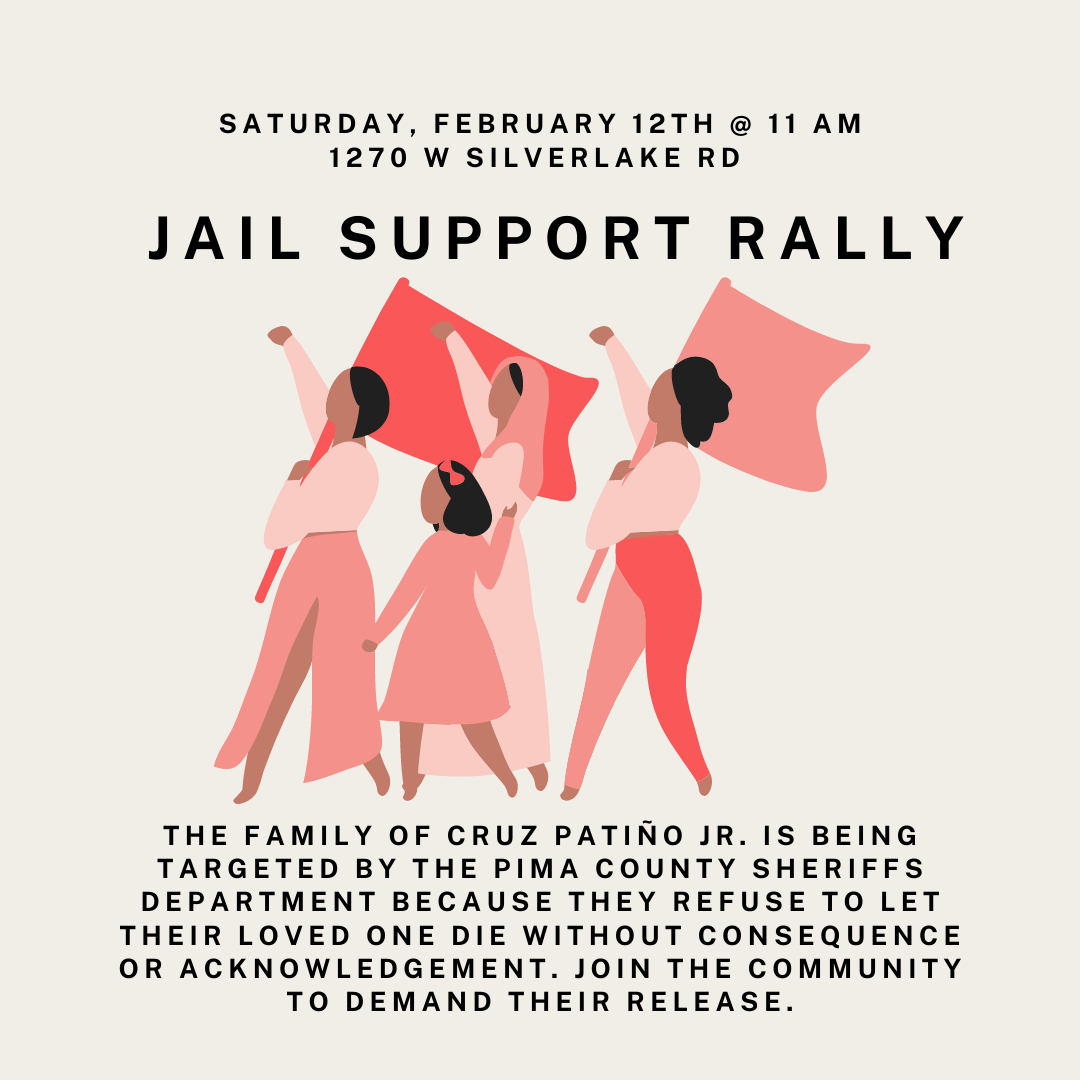
The family of Cruz Patino Jr. is being targeted by the Pima County Sheriff’s department because they refuse to let their loved one die without consequence or acknowledgement. Patino died in custody in August, hours before his mother, Frances Guzman, had a scheduled visit with him.
“Next time send out Nanos, we want to talk to him,” shouted Guzman at the protest, who has questions for the Pima County Sheriff about what happened to her son under his watch. Thirteen people have died since he assumed office in January 2021.
COMMUNITY MEMBERS WILL GATHER AT THE JAIL, TODAY AT 11AM, TO DEMAND THE RELEASE OF THE TWO MEN HELD IN CUSTODY.
KOLD News Staff, KOLD | Published: Feb. 11, 2022 at 10:17 PM MST | Last updated February 11, 2022, at 10:18 PM MST (As of March 11, 2022)
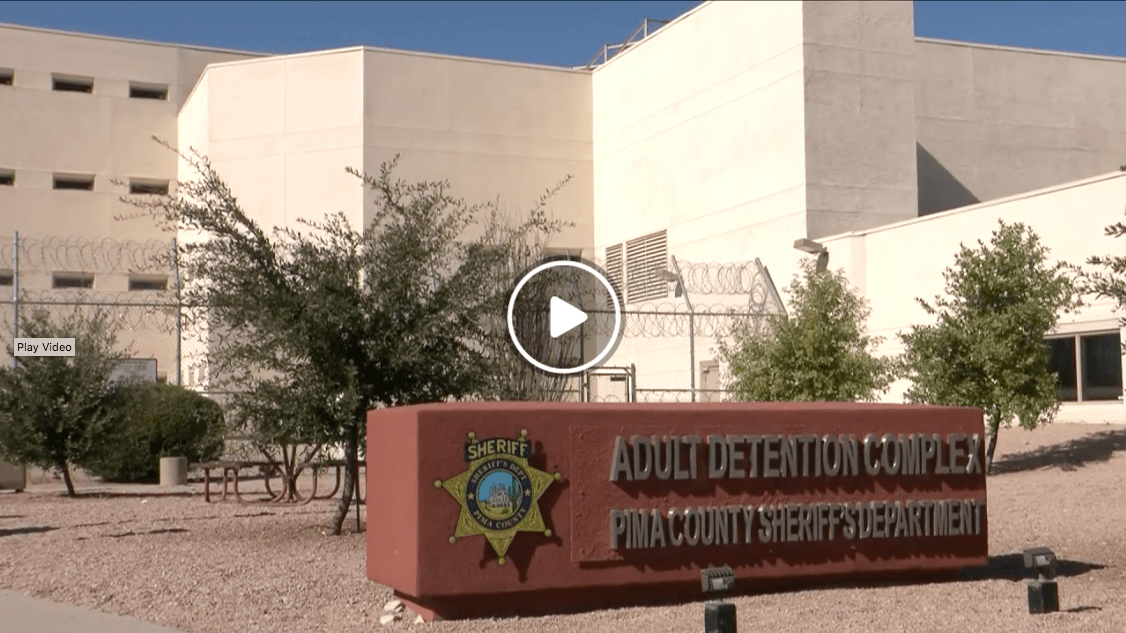
TUCSON, Ariz. (KOLD News 13) – The No More Jail Deaths Coalition held a protest outside of the Pima County Adult Detention Complex on Friday, Feb. 11, following the deaths of seven inmates within the past several months.
Many protesters held signs and banners emblazoned with the names and photos of those who died.
The protest falls on what would have been the birthday of Cruz Patino Jr. III, who died of pneumonia in the jail in August.
The coalition said in a news release sent ahead of the protest Patino’s death came hours after a nurse employed by Centurion Health examined him.
“I wouldn’t be celebrating my birthday without my son if they would have done their job in taking care of the lives that they’re responsible for,” his mother, Frances Guzman, was quoted as saying in a news release.
The family of Justin Cronk, who died in the jail in May 2021, said Sheriff Chris Nanos had done little to nothing to address families’ concerns or make any changes.
“It’s not going to help our son, but it may help someone else’s son or daughter or father or brother,” Cronk’s stepfather, Derrick Graham, was quoted as saying.
Deputies say late Friday they responded “to keep the peace.”
By Joel Feinman & Sarah Kostick, Special to TucsonSentinel.com | Posted: Feb. 8, 2022, at 10:49 AM
Joel Feinman and Sarah Kostick are public defenders for Pima County.
Last year was the deadliest year at the Pima County Jail since at least 2009. In 2021, one person died in the jail approximately every 31 days – the majority of them young men of color “found unresponsive in their cells.”
2022 is on track to be even deadlier; already this year two more young men have died in the jail’s care and custody.
On Jan. 10, a 24-year-old inmate experienced medical distress at the jail and was taken to a local hospital, where he was pronounced dead from a fentanyl overdose on Jan. 14. The other man, only 18 years old, was found dead in his jail cell in the early hours of Feb. 2. On Feb. 3 the Pima County Sheriff’s Department – which runs the jail – announced it was launching a homicide investigation into the incident.
This is an abhorrent state of affairs, and if it was happening to anyone other than our clients it would not be allowed to continue.
While most drugs are still illegal in Arizona, their possession and use is not a capital offense. To those whose first reaction to these men’s deaths is “it was their own fault,” and “they shouldn’t do the crime if they can’t do the time,” we wonder if you would be so cavalier if it was your son who died with fentanyl in his system, or your daughter who had a seizure while she was detoxing.
The young men who died were not rich, not well-known, and not members of an important voting demographic.
On the contrary as accused criminal defendants they belonged to one of the few groups it is still socially acceptable to degrade, dehumanize, and allow to die with little if any consequence.
ll the proof we need for this assertion is to look at how little was done last year to keep our clients from dying in the jail and how, so far this year, the Pima County Sheriff’s Department has done nothing different to protect them.
Moreover, the fact the Sheriff’s Department is in charge of investigating itself for wrongdoing, and no other law enforcement agency is interested, speaks to the unwillingness of the criminal justice system to protect our clients from abuse and neglect in any meaningful way.
If there is any response from the Sheriff’s Department to these most recent deaths it will likely be some version of “there is only so much we can do to help people detoxing from drugs.”
This ignores the fact that other agencies also tasked with providing detoxification services do not have the same abhorrent death rates the Pima County jail has had over the last 14 months.
The harsh reality is, if the jail cannot provide detox services to people in its custody without killing them it shouldn’t be in the detox business at all.
The Sheriff’s Department should acknowledge it is no longer able to humanely care for our clients who have acute substance abuse issues, and not admit them into the jail in the first place.
The government does not get to deprive our clients of their lives without due process of law just because it is unwilling or unable to offer medical treatment the Constitution obligates it to provide. The 5th and 14th Amendments contain no exception for indigent people, or houseless people, or people struggling with addiction
Sadly, it is virtually certain this argument will fall on deaf ears. It is a struggle to make people care about what happens in our jails and prisons, and make them understand just how dangerous and inhumane these places can be.
If one child was killed every month at a school, or one worshipper killed every month at a church, those institutions would be immediately shut down. Investigators, journalists, and enraged community members would be crawling all over the place. There would be crime scene tape and picket signs, red-faced television personalities screaming for something to be done, and prosecutors racing to file criminal charges to stop the carnage.
Elected officials would be elbowing each other out of the way to be first at the microphone to call for justice for the deceased, because politicians don’t win elections by letting schoolkids and good Christian churchgoers die.
But even after George Floyd and Carlos Ingram-Lopez and Richard Lee Richards there is no real electoral penalty for allowing people accused of crimes to die, especially if they were killed by neglect.
Many of our clients can’t vote, so why would elected leaders spend any time or political capital on them anyway? The key to public success in this town is protecting the A-10 Thunderbolt, not fathers and mothers and sons and daughters in the Pima County Jail.
We refuse to accept this arrangement. The mission statement of the Pima County Public Defender’s Office reads, “In light of our shared and inherent humanity, we challenge injustice, promote systemic change, and advocate for the fair treatment of all people by providing vigorous representation as guaranteed by the United States and Arizona Constitutions.”
Our clients in the jail are not being treated fairly or humanely. We have an obligation to them and to their families to demand this state of affairs change, and change quickly.
Our community cannot keep ignoring our clients and their suffering while simultaneously claiming to be a progressive place, dedicated to making all its residents’ lives better.
To paraphrase Plutarch, “Justice will only be achieved when those who are not injured by crime feel as indignant as those who are.” Until those of us who have never set foot in the jail are as upset as the orphaned children and grieving widows left behind by the deaths occurring behind its bars, we cannot claim to be a community of liberty and justice for all.
Joel Feinman and Sarah Kostick are public defenders for Pima County.
By Ryan Fatica, Contributor, Unicorn Riot | Originally published on Unicorn Riot
Content warning: This article contains graphic images of law enforcement violence.
Tucson, AZ – In the early hours of May 30, 2021, Justin Crook had a seizure on his way home from work. It was after midnight, and Crook had called a Lyft to drive him home following his closing shift at a downtown Tucson restaurant. Crook, who suffered from epilepsy, sometimes forgot to take his medication and trips to the emergency room were a regular part of life.
The Lyft driver called an ambulance as Crook convulsed in the back seat. When Tucson Police (TPD) officers arrived on the scene, they ran Crook’s name, found he had a warrant for a probation violation and several misdemeanors, and arrested him. By the time Crook got to the Pima County Jail, his body was covered with bruises and he was bleeding from his face and wrist. Reports indicate that he may have been tased by officers twice in the struggle.
Less than 24 hours later, Justin Crook, aka J-Mac Tha Coldest—29-year-old rapper, father of a 4-year-old daughter named Jazlin, brother to a twin sister and two younger brothers and son to loving parents—was found dead in cell #13 of the Pima County Adult Detention Complex. By the time medical workers got to him, his body was already stiff and cold—another life claimed within the jail’s cold walls of cinder block and iron.
This year alone, ten people have died in the Pima County Jail—more than in any single year in at least the last decade, according to information released by the Pima County Sheriff’s Department (PCSD) and a Reuters investigation. Although COVID has contributed to the rising death toll, only three of this year’s deaths have been attributed to the virus. It is impossible to know whether those individuals would have died had they remained outside state custody, however a study last year found incarcerated individuals to be five times more likely to contract the virus than those on the outside.
The reasons folks decided to attend are at least as numerous as how many showed up,
Since Crook’s death, the Pima County Sheriff has not made public any efforts to address the conditions at their jail that have led to so many deaths. “They acted like it was my fault that my son was dead,” said Jennifer Graham, Crook’s mother. Now, Graham and others who have lost family members in the jail this year are coming together to support each other and push back against the violence inflicted on their families.
“Once I realized that he didn’t die from what I thought he died from,” Graham said, referring to her son’s seizure condition, “then I realized that they did something to my child or they allowed something to happen to him.”
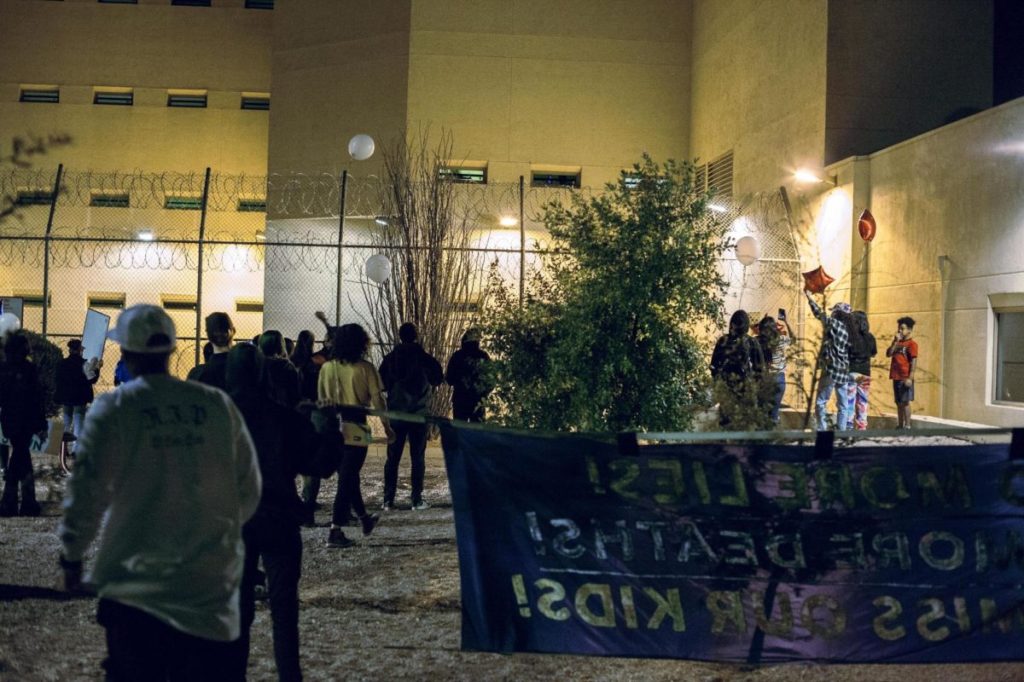
On Saturday, November 27, the group of about 50 family members and their supporters gathered in front of the Pima County Adult Detention Complex to hold a vigil in memory of their loved ones and to demand change. The group held banners reading “Jail shouldn’t be a death sentence,”“No more lies, no more deaths, we miss our kids!” and “Can’t spell coward without C.O.”
Protestors approach the fence to communicate with those inside during a vigil and protest at the Pima County Jail in November (Photo Source: Gully Theravine for Unicorn Riot).
As is the case with most people who die within this country’s sprawling apparatus of jails, prisons and detention centers, the details of Crook’s death remain opaque, the role of government agents in his death obscured behind legalistic and bureaucratic jargon. “I’ve seen so many cases thrown under the rug,” said Graham, “Especially, my son, he’s African-American. I mean, let’s not even sugarcoat it.”
“I’m still lost,” said Jamila Jackson, a longtime friend of Crook’s. “I just keep thinking, ‘how could this be real?’ Not Justin. Not J-Mac Tha Coldest.”
More than anything, Crook’s family and friends say they want answers, but those answers have not been forthcoming. Despite the desperate cries against forgetting emerging from those who loved him and hold his memory dear, it appears Crook’s death may soon become another meaningless entry in a datasheet somewhere.
As the family sifts through their fragmented memories and the enigmatic tangle of evidence in his case, a portrait emerges of a human life stamped out too early, of forestalled ambitions and wasted dreams. Although real answers remain out of reach, the pieces can be carefully examined, one after another, in hopes of making whole what was so quickly torn apart.
Jennifer Graham holds a photo of her son Justin Crook and her granddaughter Jazlin. (Source: Gully Theravine for Unicorn Riot)
“I want to go home bloody so I can press charges.”
The autopsy report in Crook’s case found evidence of numerous “blunt force injuries” that substantiate Crook’s statements to medical staff about having been beaten by TPD officers during his arrest. Details of his arrest are uncertain and TPD refused to release any information about the incident in a timely manner.
Crook’s family members report that when he had seizures, he would come out of them disoriented and upset, a situation that could contribute to a dangerous encounter with the police if they respond, as they so often do, with aggression rather than medical care.
“The driver called 911 to get me help and they picked me up on a warrant,” Crook told jail staff, according to jail records. “I was out of it from the seizure. You know how you come out of a seizure kinda crazy!”
At the time of his death, Crook had a black eye, two “punctate red abrasions” on his right cheek and two more on his shoulder, and several bruises on his head. His body and arms were covered in abrasions and bruises, including scrapes on his wrists and a 6 inch by 6 inch V-shaped bruise on his abdomen. But, according to the Medical Examiner’s findings, none of this evidence of violence is what actually killed him.
Jail medical reports say that Crook was “brought in as combative, in a WRAP, by TPD and refusing to follow the instructions of custody staff.” A WRAP is a full body restraint device patented and sold by Safe Restraints Incorporated, a California-based company. The device is marketed as a “safe” and even “comfortable” alternative to hog tying, where a person’s arms are tethered to their ankles behind their back.
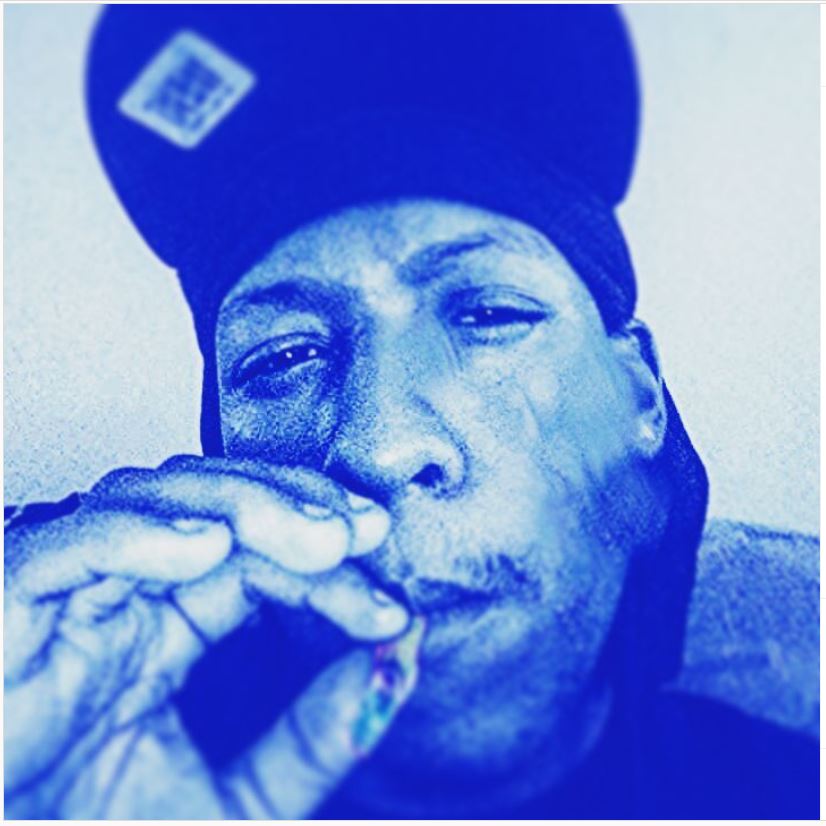
Figure Justin Crook in 2017 (Photo Source: Instagram).
The Tucson Police Department adopted the WRAP system in December 2020 in response to public outcry following the deaths of Carlos “Adrian” Ingram-Lopez and Damien Alvarado, both of whom were killed by police while restrained in 2020. While Ingram-Lopez was double-handcuffed and pinned down by police when he died, Alvarado was restrained using a “Total Appendage Restraint Procedure” or TARP, also known as hog tying.
TPD marketed their new restraint system as a humane alternative to their previous methods and as demonstration of the department’s commitment to reform. But the WRAP restraint system has been long implicated in numerous in-custody deaths, including the 2018 death of Earl McNeil in San Diego County, CA, Steven Hankins in Concord, CA and Eugene Jimerson Jr in Hayward, CA.
In medical records from the jail, staff wrote that Crook “presents as agitated/aggressive and is paranoid about staff wanting to harm him, and perseverates on wanting to press charges and the events leading up to the situation.”
The reports also show that Crook refused to have his wounds cleaned by staff because he wanted to preserve evidence of having been beaten by police. Crook “refused each time stating it was his right and that he need [sic] it for evidence against custody,” staff wrote in the report. Staff later wrote that Crook said, “I want to go home bloody so I can press charges.”
Records also indicate that jail medical staff may have been performing their interview and treatment in the presence of jail staff or police who Crook did not trust or from whom he feared violence. “I won’t let you touch me until they [custody staff] are gone,” the report quotes Crook as saying.
Despite noting in their earlier reports that Crook seemed to be under the influence of methamphetamines, jail staff took no steps to enact any overdose prevention protocols in his case. In an email to Unicorn Riot, the PCSD explained that they took no detox or substance use precautions in Crook’s case because he refused medical treatment at the jail.
“Normally, an inmate identifies and cooperates with medical staff on substance use and withdrawal,” a representative of the PCSD said in an email statement to Unicorn Riot. “This is not the case as Mr. Crooks [sic] refused all attempts by medical staff to do an evaluation.”
The jail reports, mostly covering the period from 2 a.m., when Crook was brought to the jail, to 8 a.m. the same day, paint a picture of Crook as combative and uncooperative. “Current presentation is consistent with methamphetamine intoxication,” jail staff wrote in their report at 6:10 a.m. But surveillance camera footage from a few hours later shows Crook unrestrained and seemingly calm, changing into an orange jumpsuit at the request of guards and calmly walking with them through the halls to his cell.
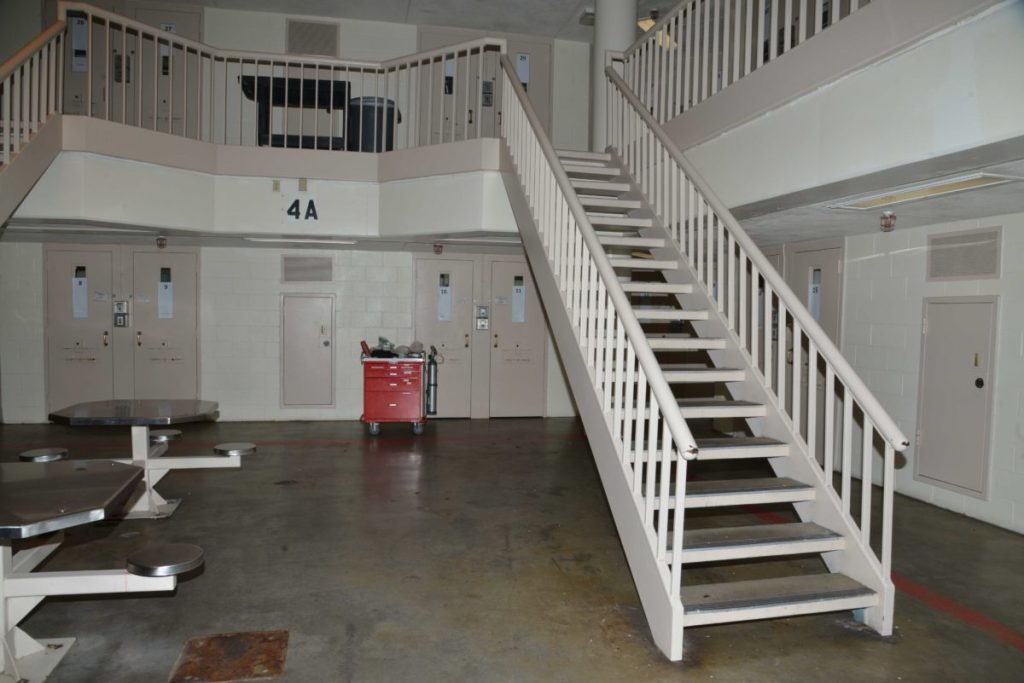
Unit 4A of the Pima County Adult Corrections Complex where Justin Crook died in May 2021. (Source: Pima County Sheriff’s Department)
At 11:47 a.m. on May 30, Crook was led unrestrained to Unit 4A, cell #13 and walked into the cell without resistance. In the footage, he appears to be talking normally to the guards and shows no signs of the agitated state one would expect from someone under the influence of a fatal dose of methamphetamines.
The PCSD said in an email that jail staff perform “rounds” every 20 minutes and that, according to their review of surveillance footage, jail staff checked on Crook at 2:12 a.m. and 2:33 a.m. Based on medical reports from the time of his death, Crook was likely already dead when guards performed these rounds, but did not notice or provide him help.
Despite the hours of surveillance camera footage and the dozens of pages of reports, for Crook’s family and friends, the mystery of his death remains. “There are a lot of dots that are not connecting,” said Sierra Lee, Crook’s friend. “And there’s no answers.”
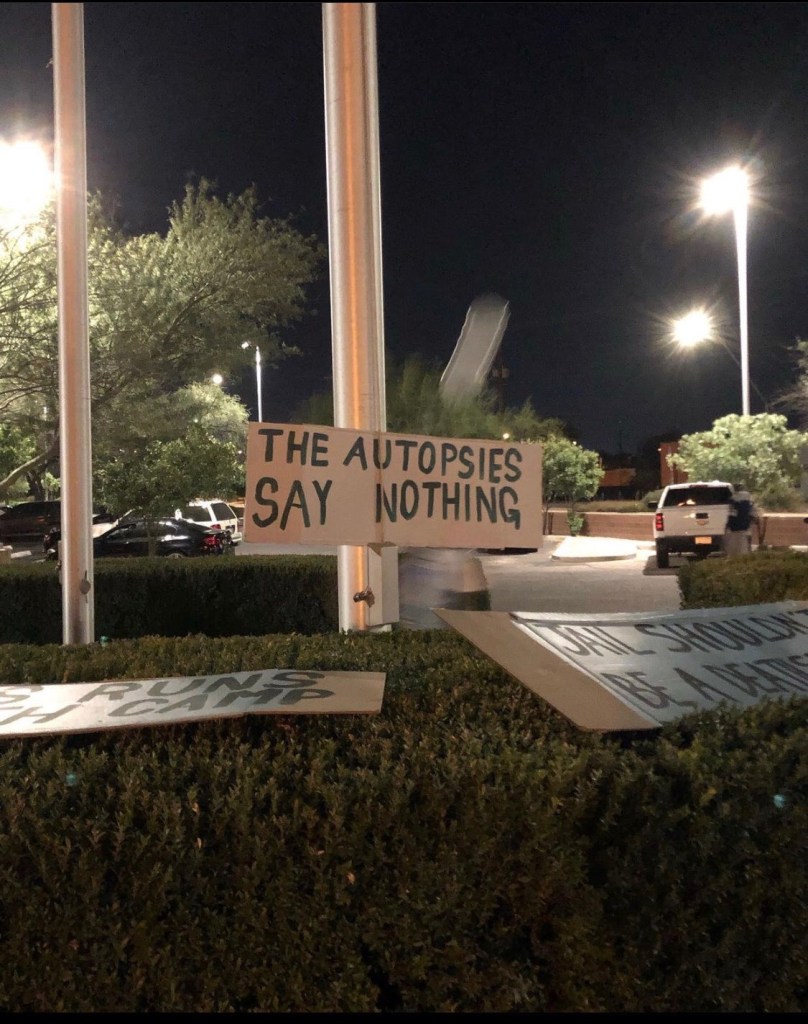
A sign left outside the Pima County Jail during a November 2021 vigil reads “The Autopsies Say Nothing.” (Photo: Piper Layne for Unicorn Riot)
“The Autopsies Say Nothing”
According to the medical examiner’s autopsy and toxicology reports, at the time of his death Crook’s body contained many times the average single dose of methamphetamines. According to these findings, Crook at some point consumed enough meth for the medical examiner to rule that he died of “acute methamphetamine intoxication.” If that finding is correct, the key questions become: When did he take those drugs and where did they come from?
The Pima County Medical Examiner ruled Crook’s death an accident. Graham doesn’t accept that explanation: “How do you overdose from methamphetamine intoxication when he was on their property for 30 hours? That makes no sense.” Although she doesn’t dispute that her son had issues with drugs, Graham says she doesn’t think the jail’s story adds up. “It’s just a lot of red flags there. Their stories are inconsistent. You know, they did not expect me to pursue this.”
As has been noted, information from autopsy reports is often manipulated to obfuscate the involvement of law enforcement in the deaths of those in their custody. In an interview with Perilous Chronicle earlier this year, Dr. Gregory Hess, Chief Medical Examiner for Pima County explained that autopsy reports prepared by his office do not take into account superseding conditions, such as the inherent dangers of incarceration, forced confinement within a congregate setting during a pandemic, medical neglect, or conditions of confinement.
“We’re just the cause of death folks,” said Hess. “We tell people what happened as factually as we can. So when people have questions about standard of care and whether things were done correctly, people can have those questions but it’s not usually us who’s opining about it.”
Vigil in front of the Pima County Jail in November 2021 (Photo Source: Gully Theravine for Unicorn Riot).
Autopsy reports in the case of Carlos “Adrian” Ingram-Lopez, who was killed by Tucson police in April 2020, initially found that he had died of “sudden cardiac arrest in the setting of acute cocaine intoxication and physical restraint.” A later, independent autopsy found that Ingram-Lopez died of “suffocation” and body camera footage clearly shows his slow suffocation by Tucson Police Officers who ignored him as he told them he couldn’t breathe.
The officers later resigned, but no criminal charges were brought against them. Autopsy findings in the case were used by the former Pima County Attorney, Barbara LaWall, to justify her refusal to indict the officers.
In the case of George Floyd, who was murdered by the Minneapolis Police Department in May 2020, an autopsy report was used to bring attention to the presence of drugs in Floyd’s system and a preexisting heart condition and away from the knee on his neck that killed him.
“They almost beat me to death”
Graham believes that her son’s death has something to do with an incident that occurred in the jail almost one year earlier, when Crook was arrested on a misdemeanor warrant and failure to appear at his court date.
“They ended up beating the crap out of my son,” Graham said. “Put him in the hospital.”
In May 2020, Crook was arrested after Tucson Police Officers responded to a call from Graham who was concerned about an argument Crook had gotten into with his girlfriend. “I just called them to go over and do a wellness check,” Graham said. When they arrived, officers found drug paraphernalia and arrested Crook on several misdemeanors including “disorderly conduct” and refusing to give his name.
Crook was released and, after missing his court date, Tucson City Court Judge Susan Shetter issued a warrant for his arrest. Crook was arrested three weeks later and incarcerated at the Pima County Jail.
Accounts of what happened next differ. According to Corrections Officer Fernando Amador, Crook, who he claimed he’d never spoken to before in his life, sucker punched him in the face without provocation. In response, CO Amador and several other officers “entered the room in attempt to secure that inmate to the ground,” according to incident reports obtained by Unicorn Riot. “CO Amador stated he struck the inmate a couple times in the face area,” the report reads. “Ultimately, a taser was utilized by another CO and they were able to get the inmate out of the cell and secure him into a restraint chair.”
Justin Crook in a “restraint chair” at the Pima County Jail in July 2020. (Source: Pima County Sheriff’s Office)
Crook’s side of the story is harder to obtain as he did not author the many reports of the incident and has since died in the jail, taking his story with him. What does remain is an interview with Crook, conducted by an investigator with the PCSD. The recording, conducted shortly after the beating, is his only remaining testimony of the event.
In audio of the interview obtained by Unicorn Riot, Crook’s voice is tense, almost a whisper. His breathing is labored and he struggles to speak though a swollen mouth. He sounds exhausted, and his voice cracks with emotion. He repeatedly says that he is giving his testimony under duress, that he does not feel he has a choice, that he fears retaliation for what he says.
At one point, the investigator tells Crook to not worry about the guards and to just focus on telling his story. Crook replies, eerily, “It’s hard to do with the person who almost killed you standing right behind you.”
Justin Crook after he was beaten by guards in the Pima County Jail in July 2020. (Source: Pima County Sheriff’s Department)
When asked what happened between himself and CO Amador, Crook admits to punching the officer as he opened the door of his cell. When asked why he did it, Crook says: “He said a remark about my dead friend.”
“I’m not a fucking punk,” Crook continues, “I miss my friend. I’m not gonna be cool with nobody disrespecting his presence. And I’m willing to die for that. OK? So I almost did.”
Surveillance camera footage of the incident obtained by Unicorn Riot shows Amador and a group of officers moving a detainee down the hall of Unit 1S and stopping in front of cell #3. As the jail cell door slides open, a hand emerges from the cell, punching Amador in the face. Amador and two other officers—C.O. Quijada and Corrections Sergeant Grimsey, immediately enter the dark cell, disappearing from direct view of the camera, while a fourth—CO Reyes—leads a detainee down the hall, securing him in another cell.
When Reyes returns, he stops in the doorway of the cell, staring intently inside, watching. He does not enter the cell. He makes no move to help the officers inside, as one might expect if a detainee were resisting. He fidgets with the cell door, adjusts his mask. Several times he seems to consider turning to leave. He remains at the cell door, staring. Over a minute later he disappears into the dark cell.
Six-and-a-half minutes after the officers initially enter the cell, they drag Crook out and put him into a restraint chair. A nurse approaches to check Crook’s vital signs, managing the body so recently damaged by her co-workers.
In the interview with Crook, despite being severely injured and certainly aware that he will face assault charges, Crook expresses no remorse for his actions. His voice, previously restrained and low, becomes strong as he describes his actions as well as the code to which they adhered.
“He disrespected my friend,” he says. “You think I give a fuck about getting beat up for that? It was the right thing to do.” “I’d do it again,” he says.
“What was your friend’s name?” the officer asks.
“Anthony Garrett.”
The officer repeats the name, “Anthony Garrett?”
Like a call-and-response, or a sacred invocation, Crook says the name again. “Anthony Garrett.”
Anthony Garrett. (Source: Facebook)
Anthony L. Garrett, 24, was killed by security guards in June 17, 2019, at a business on East Broadway Boulevard where his ex-girlfriend worked. According to official accounts, Garrett had been involved in a domestic violence situation with the woman earlier that month and had gone to her work looking for her. During a gunfight with security guards, Garrett was killed.
In the recording, Crook’s voice cracks with emotion as he talks about his friend in whose honor he has brought upon himself so much suffering: “I just wanted my friend to know…I love you and miss you bro. Straight up.”
As a result of the altercation at the jail, Crook was charged with “Aggravated Assault on a Corrections Employee,” a class five felony. None of the officers involved were charged with crimes. In December 2020, Crook pleaded guilty to a lesser charge of “Attempt to Commit Aggravated Assault on a Corrections Employee,” a class six felony, and was sentenced to three years’ probation.
“I personally think he was too good for this Earth.”
Justin Crook with his twin sister Justine in October 2018. (Source: Justine Crook)
Justine Crook, Justin’s twin sister, says she wishes she could have taken some of her brother’s suffering into herself. “You can tell when someone’s really sick,” said Justine, “and I felt like my twin was really sick.”
Mental health issues run in Crook’s family, and in adolescence he started showing signs of the mental illness and substance abuse he would wrestle with the rest of his life. Years later, he would be diagnosed with bipolar disorder and schizophrenia as well as post-traumatic stress disorder.
In her hardest moments, Justine thinks her successes in life may even be attributable to the suffering of her twin, her mirror image and lifelong counterpoint in the world. “He took all the bad problems when we were in the womb,” Justine said. “He took everything bad.” Like a sponge that absorbed all her hardships, leaving her to succeed.
In the weeks before he died, Crook had been working a new job and writing music and trying to get his life on track for his daughter. “We got some blessings with this music shit,” said Crook in a text to his friend Dale Francisco, a Tucson hip-hop artist and producer who uses the alias Teknik, two weeks before he died.
“Been a long time coming but I think we can really jump off at least locally for sure,” Crook wrote. He told Francisco he had a notebook full of songs and asked the more established rapper to help him record an album: “I wanna work on my mixtape all year then release it in January. 10 songs perfected.”
Despite his mental health struggles and occasional problems with the law, Crook never stopped reading and never stopped rapping. “He could just sit there all day and read a book,” said Justine. “He was the smartest person I’ve ever known.”
“I personally think he was too good for this Earth,” said Justine. “I feel like God took him because he was way too good to walk this Earth.”
On the night of his death, Crook messaged his mom on Facebook, saying he was having a hard day. He was worried about his daughter Jazlin and an argument he’d gotten into with her mother. Graham could tell he was feeling down. “I told him, son tomorrow could also be a better day,” said Graham. “And so those were my last words to my son.”
Crook’s friends and family still don’t have the answers they need, and the institutions that ended his life remain unresponsive to their demands. Nevertheless, they find solace in their memories, in watching Crook’s daughter grow, in the support of others who have lost children to the jail, and in their efforts to seek justice in his case.
Graham and her husband have hired an attorney, Amy Hernandez, to investigate their case and filed a lawsuit against the PCSD in November.
A week after Crook’s death, Justine went to North Carolina to visit the ocean and to mourn the loss of her brother. As she sat on the sand, watching the waves crash onto the beach, she knew that from that point on her twin would be looking through her eyes and experiencing the world through her.
“You feel this twin?” she asked her brother aloud, watching the waves. “This is what life is about.”
On Saturday, November 4, we called for a protest to meet at the corner of 4th and Broadway in response to the murder of Richard Lee Richards, the brutal assault of two people in a restaurant parking lot by Tucson Police Officer Robert Szelewski, and the news of yet another death in the Pima County Jail—the tenth person to die behind its walls this year. The protest was called by a coalition of individuals and groups in Tucson who are concerned about the effect that law enforcement and their violence have on our communities.
Our call was answered by about 150 people who came with their own goals and intentions, drawn together by the common cause of holding the Tucson Police Department (TPD) and the Pima County Sheriffs to account for their actions. The crowd that gathered marched through the downtown area, eventually meeting up with another group that had called for a protest that met earlier in the evening.
We called for the protest because we’re fed up with the official channels that are offered to us, and because we don’t believe that the cops will ever change until we make them change. On Monday, November 29, Officer Ryan Remington murdered Richard Lee Richards for shoplifting and for disobeying his orders. On November 14, Officer Robert Szelewski pinned two women to the ground because they got in his way in a parking lot. These incidents expose the soul sickness of police, whose jobs warp their psyches and inure them to violence. There’s not a single progressive reform that will solve this problem. We have to be rid of the police once and for all.
Tucson’s government and law enforcement project an image of a “progressive” oasis amidst a red state, but the body count belies the dark reality behind this thin veneer. TPD is out of control, Sheriff Nanos’ jail keeps handing out death sentences to the poor, mentally ill and drug addicted, and all the while our so-called “progressive” prosecutor, Laura Conover, sits on her hands, writing op-eds with the cops, calling for a tough-on-crime agenda. People of conscience are left with little choice but to take matters into their own hands.
In the summer of 2020, people collectively devastated downtown Tucson in response to the national crisis of policing. People then called for Tucson to be a beacon of light to the country by defunding the police and prioritizing our actual needs. Instead, what we got from the mayor and the city council was a $2 million budget increase for TPD and an impotent prosecutor who capitalized on our momentum to build her career. We’re sick of waiting around for them to change things while people keep dying. We haven’t forgotten Carlos Ingram Lopez, who was murdered by TPD last year by Officers Ryan Starbuck, Jonathan Jackson, and Samuel Routledge in a manner strikingly similar to the murder of George Floyd. We haven’t forgotten Damien Alvarado, who was also suffocated to death by TPD last year. We haven’t forgotten the ten individuals who died in the jail this year who should still be with us.
We believe in a world without the police and we won’t stop until we get it.
The value of individual life a credo they taught us to instill fear, and inaction, ‘you only live once’ a fog in your eyes, we are endless in a sea, not separate, we die a million times a day, we are born a million times, each breath life and death: get up, put on your shoes, get started, someone will finish.”












 NO JAIL DEATHS